
Protein, Muscle Mass, and Weight Loss
May 6, 2026
Learn how protein supports muscle mass and weight loss, effective tracking with Rejuvify for optimizing wellness and dietary habits.
Protein, Muscle Mass, and Weight Loss: Why Visibility Matters
For many people, weight loss starts with a simple objective: reduce body weight and improve health. But over time, many discover that the process is more complicated than the number on the scale alone.
Energy fluctuates. Hunger changes. Routines drift. Strength may decline even while weight drops. And despite good intentions, it often becomes difficult to understand whether progress is actually supporting long-term health — or quietly working against it.
One of the most important factors in sustainable weight management is the preservation of muscle mass during periods of weight loss.
Muscle is not only linked to strength and physical performance. It also plays a major role in metabolism, energy expenditure, stability, mobility, and long-term vitality. Losing weight while unintentionally losing lean mass can make it harder to maintain progress over time and may contribute to lower energy, reduced physical function, and slower metabolic adaptation.
This is why protein intake, recovery, strength-related activity, and behavioral consistency matter together — not as isolated actions, but as interacting patterns across time.
Weight Loss in the Era of GLP-1 Medications
The conversation around weight management has changed rapidly with the increasing visibility of GLP-1–based medications and other appetite-modulating approaches.
Weight loss is no longer limited to individuals with severe obesity or clinical weight-management programs. A growing number of people across broader wellness and lifestyle populations are now actively pursuing weight reduction — often at faster rates than in previous decades.
This shift has increased attention on an important question:
What happens during weight loss beyond the number on the scale?
As appetite decreases and caloric intake changes, factors such as protein intake, strength-related activity, recovery, and lean mass preservation may become increasingly relevant. In this context, maintaining muscle-supportive behaviors during weight-loss phases is becoming a broader wellness discussion rather than a niche fitness topic.
The challenge is that these patterns are often difficult to recognize without visibility across nutrition, activity, recovery, and body-composition trends over time.
Why Protein Matters More Than Most People Realize
Protein supports muscle repair, recovery, and maintenance. During weight-loss phases — particularly when calories are reduced — adequate protein intake becomes increasingly important because the body may otherwise break down lean tissue alongside fat stores.
Research consistently suggests that sufficient protein intake may help support:
- muscle preservation during caloric deficits
- recovery after strength-related activity
- satiety and appetite regulation
- metabolic stability during weight loss
But in practice, most people are not failing because they lack information about protein.
The challenge is consistency.
Meals change from day to day. Work schedules interfere with routines. Travel disrupts planning. Appetite fluctuates. Recovery varies. Under real-life conditions, maintaining stable behaviors becomes difficult without visibility into what is actually happening over time.
The Problem With Isolated Metrics
Most people already have fragments of their wellness data scattered across apps and devices:
- steps
- workouts
- calories
- sleep
- body composition
- heart rate
- meals
- recovery scores
The issue is rarely lack of data.
The issue is interpretation.
A person may be losing weight while also:
- under-consuming protein
- reducing strength activity
- accumulating fatigue
- sleeping poorly
- losing lean mass too quickly
Without context across time, these patterns often remain invisible until progress stalls or physical performance declines.
This is where behavioral interpretation becomes important.
How Rejuvify Helps Organize the Bigger Picture
Rejuvify was designed to help users understand how nutrition, movement, recovery, body composition, and daily routines interact under real-life conditions.
Rather than functioning as a simple calorie tracker or fitness dashboard, the platform organizes wearable-derived signals and behavioral inputs into broader patterns that are easier to interpret over time.
By combining nutrition tracking, wearable integrations, recovery signals, activity trends, meal planning, body composition insights, and behavioral pattern analysis, Rejuvify helps users build greater visibility around the habits that shape sustainable progress.
The platform introduces structured wellness indicators designed to make these patterns more understandable.
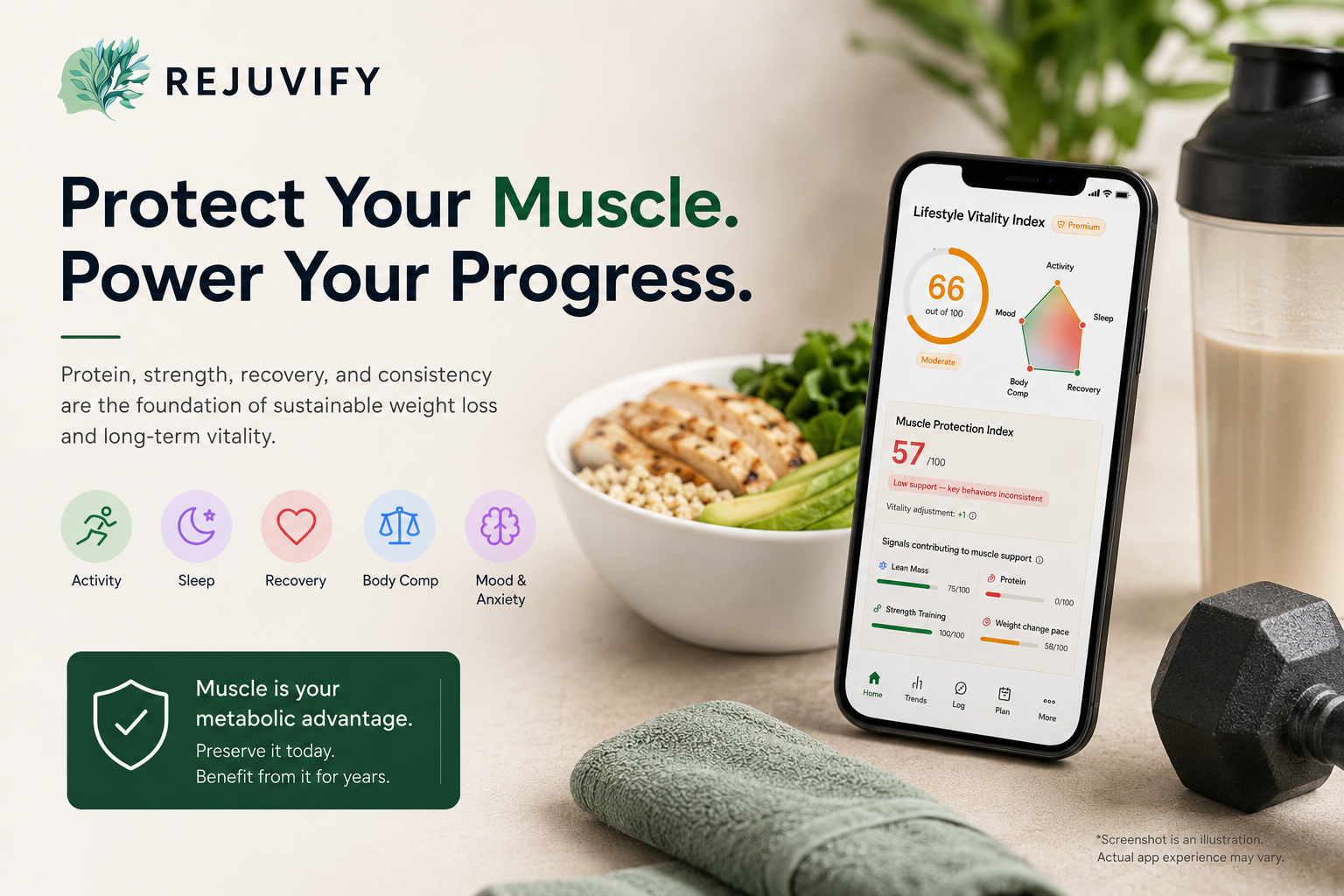
The Lifestyle Vitality Index provides a broader behavioral overview across:
- activity
- sleep
- recovery
- body composition
- mood and behavioral consistency
This helps users recognize whether their overall patterns appear stable, fragmented, or drifting under everyday conditions.
The Muscle Protection Index focuses more specifically on behaviors associated with preserving lean mass during weight-loss phases.
It organizes signals related to:
- protein intake patterns
- strength-related activity
- lean mass trends
- recovery status
- weight-change pace
The objective is not to create medical assessments or perfection-based scoring systems. The purpose is to provide clearer context around patterns that are otherwise difficult to interpret in isolation.
For example, a user may notice:
- strong activity levels but inconsistent recovery
- rapid weight loss combined with low protein intake
- declining lean mass despite overall scale progress
- stable movement patterns but poor sleep consistency
These interpretations help shift attention away from isolated daily fluctuations and toward the broader behaviors that influence long-term sustainability.
Visibility Changes Behavior
Most behavior change does not happen because someone suddenly becomes more motivated.
It happens because patterns become visible.
When users can clearly see:
- how protein intake changes across a week
- how recovery shifts after periods of stress
- how strength activity influences lean mass trends
- how routines drift under inconsistent schedules
…it becomes easier to make adjustments before patterns deteriorate further.
This is where structured tracking environments become valuable.
Not because they replace discipline or decision-making — but because they reduce ambiguity.
Beyond Weight Loss Alone
Sustainable progress is not simply about reducing body weight.
It is about maintaining the systems that support long-term health, physical capability, energy, and repeatability across real life.
This includes:
- preserving lean mass
- supporting recovery
- maintaining stable movement patterns
- avoiding excessive behavioral fragmentation
- building routines that remain realistic over time
Technology alone cannot solve these challenges.
But clearer behavioral visibility can make them easier to understand.
Try Rejuvify
Rejuvify helps organize fragmented wellness data into interpretable behavioral patterns across nutrition, activity, recovery, body composition, and muscle-supportive behaviors.
Instead of relying on isolated numbers or motivation alone, the platform helps users better understand the interaction between daily decisions and long-term outcomes.
Users can track:
- nutrition and protein intake
- wearable-derived activity and recovery signals
- body composition trends
- sleep and behavioral consistency
- strength-related activity patterns
- muscle-supportive behaviors during weight-loss phases
The platform’s Lifestyle Vitality Index and Muscle Protection Index help translate fragmented data into clearer behavioral context across time.
Trying Rejuvify is free for the first 24 hours — that’s on me.
Disclaimer This content is intended for general wellness education and informational purposes only. It does not provide medical advice, diagnosis, or treatment recommendations. Individual responses to nutrition, activity, recovery, and weight-management strategies vary. Users should consult qualified healthcare professionals before making significant changes to health-related routines.